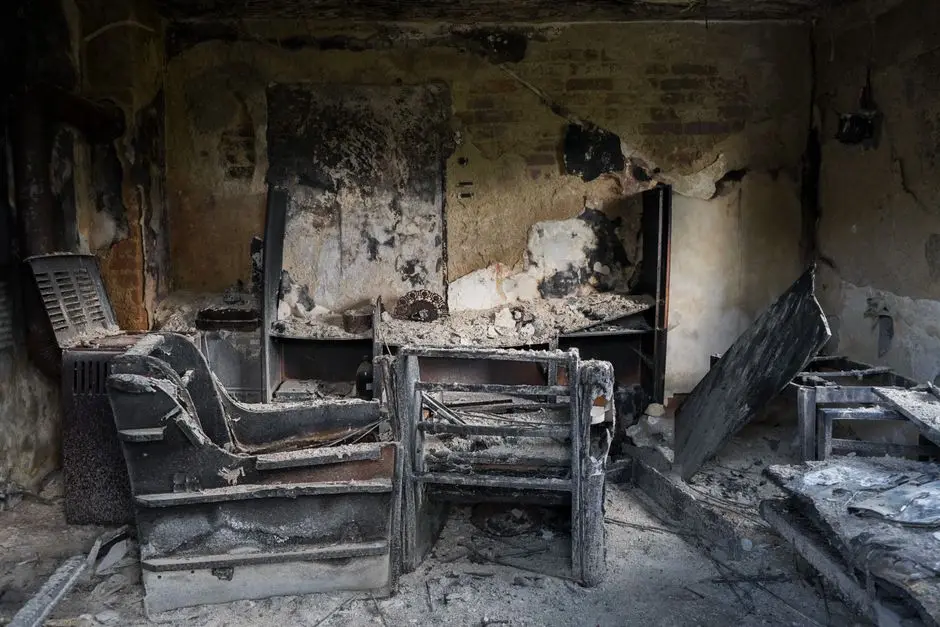
Your house still smells like smoke after a fire because the odor isn't coming from the visible char - it's coming from microscopic soot and smoke particles that have soaked into drywall, insulation, wood framing, HVAC ducts, and soft furnishings. Those particles off-gas for months, and every time humidity rises or the furnace kicks on, they release that acrid smell back into your living space. This post explains exactly where the smell hides in a MONTROSE home, why it returns after DIY cleaning, and the steps that actually remove it.
The short answer: smoke odor is trapped, not gone
Smoke odor after a fire is a gas-and-particle problem, not a surface-stain problem. When materials burn, they release thousands of compounds - benzene, formaldehyde, acrolein, and fine carbon particles - that are small enough to penetrate porous surfaces. Wiping down a wall removes what's on the surface. It does nothing for what's already inside the drywall paper, the insulation behind it, or the subfloor.
That's why a house can look clean and still smell like a campfire three weeks later. The residue is embedded, and it keeps releasing molecules into the air. In MONTROSE, where summer temperatures regularly push past 95°F and winter air gets dry, that off-gassing cycle speeds up and slows down with the seasons - which is why the smell seems to "come back" right when you think it's gone.
Professional Odor Removal After Fire in MONTROSE, California addresses the source, not the surface. That distinction is the whole ballgame.
Where smoke smell hides in a MONTROSE house
Smoke travels through a home the same way air does - through every gap, duct, and penetration. In MONTROSE's older housing stock, especially the mid-century ranches and bungalows, that means the smell ends up in places most homeowners never think to check.
The five most common hiding spots we find
- HVAC ducts and the air handler. Smoke gets pulled into the return and coats the inside of the ductwork. Every time the system runs, it redistributes odor through the whole house. This is the number one reason a house smells like smoke in rooms that never had flames.
- Attic insulation and roof decking. Heat and smoke rise. Attic fires or kitchen fires that vent upward leave residue on rafters and fiberglass batts that acts like a sponge.
- Wall cavities and outlet boxes. Smoke penetrates through electrical penetrations and settles inside the cavity. You can't reach it with a sponge.
- Upholstery, mattresses, and carpet padding. Foam and fabric absorb smoke like a filter. Shampooing the surface doesn't reach the padding underneath.
- Subfloor and framing after water exposure. If water was used to fight the fire, smoke residue wicks into wood and stays there. That's why we often handle Fire and Flood Restoration in MONTROSE, California as a combined job.
We've pulled smoke odor out of homes in every corner of the valley, from the older blocks near Fire Damage Restoration in Downtown Montrose to the newer builds out toward the Fire Damage Restoration in Uncompahgre Valley. The hiding spots are the same. The difference is how much of the structure is porous.
Why the smell comes back after you clean
Smoke smell returns after cleanup because the cleaning only reached the top layer. Here's what's actually happening when the odor reappears days or weeks later.
First, soot particles are acidic and oily. They bond to surfaces and continue to release volatile organic compounds (VOCs) as they break down. A vinegar-and-water wipe neutralizes some surface acidity but doesn't penetrate. Second, humidity is a trigger. On a muggy day or when you run a humidifier, moisture opens the pores of drywall and wood, and trapped VOCs escape faster. Third, heat does the same thing - turning on the furnace or baking in a west-facing room accelerates off-gassing. Fourth, negative air pressure from exhaust fans and dryers pulls stale air out of wall cavities and ducts, carrying odor with it.
That's why the smell seems to "return" even after a deep clean. It never left. You just stopped smelling it for a few days.
How to get smoke smell out of house after fire MONTROSE
Removing smoke smell from a house after a fire in MONTROSE requires a sequence: remove the source, neutralize the residue, seal what can't be removed, and then treat the air. Skipping a step is why DIY attempts fail.
- Remove char and unsalvageable porous materials. Drywall, insulation, carpet, and padding that have absorbed smoke usually have to go. This is the step most homeowners skip, and it's the one that matters most.
- HEPA-vacuum and dry-sponge all surfaces. Soot removal has to happen before any wet cleaning, or you'll smear oily residue deeper into the surface. Our Soot Removal in MONTROSE, California techs use dry chemical sponges on walls and ceilings first.
- Clean and seal structural cavities. Exposed framing, subfloor, and sheathing get cleaned, then sealed with a shellac-based primer that locks in residual odor. This is the step that stops the smell from coming back.
- Clean the HVAC system. Ducts, the blower, and the evaporator coil need to be cleaned and the filter replaced. If the system was running during the fire, this is non-negotiable.
- Treat contents and soft goods. Upholstery, mattresses, clothing, and drapes need ozone, hydroxyl, or thermal fogging treatment - sometimes all three. Hard furniture may need Fire-Damaged Furniture Restoration in MONTROSE, California.
- Run air scrubbers and odor counteractants. HEPA air scrubbers with activated carbon run for 3-7 days, depending on how deep the smoke penetrated. Ozone or hydroxyl generators finish the job.
Typical 2026 pricing for full smoke odor removal in a MONTROSE single-family home runs $2,500-$8,000, depending on square footage and how much porous material has to be removed. A single-room kitchen fire with no duct contamination can come in under $2,000. A whole-house job with attic and duct involvement can exceed $12,000.
Common mistakes that make smoke odor worse
The wrong DIY move can drive smoke residue deeper and make professional removal more expensive. Here's what we see most often.
- Painting over soot without sealing. Latex paint over smoke residue traps odor and eventually peels. You need a shellac or oil-based stain-blocking primer first.
- Running the HVAC right after the fire. This pulls smoke deeper into the ducts and distributes it through every room. Leave the system off until it's been cleaned.
- Using a wet vac or steam cleaner on soot. Water drives oily soot into drywall paper and wood grain. Dry methods first, always.
- Masking with candles, plug-ins, or air fresheners. This adds fragrance on top of smoke and makes the problem harder to diagnose later.
- Assuming the smell will fade on its own. It won't. Smoke VOCs can persist for 12-24 months in porous materials without treatment.
- Cleaning only the room where the fire happened. Smoke migrates. The room that smells worst is often not the room that burned.
If you're not sure whether the smell is surface-level or structural, a professional assessment is cheaper than a failed DIY attempt. Our team handles Smoke Damage Restoration in MONTROSE, California with moisture meters, thermal imaging, and air sampling to find the source before we quote the work.
When to call a professional
Call a professional when the smoke smell persists more than 7-10 days after the fire, when it returns every time the HVAC runs, or when anyone in the house has headaches, coughing, or irritated eyes. Those are signs of ongoing VOC exposure, not just a lingering scent.
You should also call if the fire involved synthetic materials (plastics, foam, electronics), if the attic or ductwork was exposed, or if water was used to extinguish the fire. Those situations almost always require cavity cleaning and sealing that DIY tools can't reach. Fire Damage Restoration Montrose handles Emergency Fire Damage Restoration in MONTROSE, California and full odor remediation across the valley - we'll tell you honestly whether the job needs a full remediation or just a targeted treatment.
Frequently Asked Questions
Why does my house still smell like smoke after a fire in MONTROSE California?
Smoke particles have soaked into porous materials - drywall, insulation, ducts, upholstery - and are off-gassing VOCs. Surface cleaning doesn't reach them. In MONTROSE's dry climate, the smell often seems to fade then returns when humidity or heat rises.
How long does smoke smell last after a fire in MONTROSE?
Without professional treatment, smoke odor can persist 12-24 months in porous materials. With proper source removal, sealing, and air treatment, most MONTROSE homes are odor-free within 7-14 days of the remediation start date.
How do I remove smoke smell from my house in MONTROSE California?
Remove char and unsalvageable porous materials, HEPA-vacuum and dry-sponge all surfaces, seal cavities with shellac primer, clean the HVAC system, and run air scrubbers with carbon filtration. DIY methods that skip the sealing step usually fail within weeks.
Who can remove smoke odor after a fire in MONTROSE?
Fire Damage Restoration Montrose provides professional smoke odor removal across MONTROSE, including duct cleaning, cavity sealing, ozone and hydroxyl treatment, and contents restoration. Call (833) 929-6186 for an assessment.
Why does smoke smell return after fire cleanup in MONTROSE California?
The cleanup likely didn't reach the source. Humidity, heat from the furnace, or negative air pressure pulls trapped VOCs out of wall cavities and ducts. Sealing those cavities is the step that stops the cycle.
Get help with Fire Damage Restoration in MONTROSE
If your house still smells like smoke after a fire, the source is almost certainly in a cavity, duct, or porous material you can't see. We find it, remove it, and seal it so the smell doesn't come back. Call Fire Damage Restoration Montrose at (833) 929-6186 for a same-day assessment.